
Commercial HVAC Grille Selection Guide | Vic Air Supplies
Blog | 9 Dec 2025 |
Commercial Grilles 101: Matching Aesthetics with Airflow
The most dangerous person on a commercial fit-out isn't the electrician or the plumber.
It’s the interior designer.
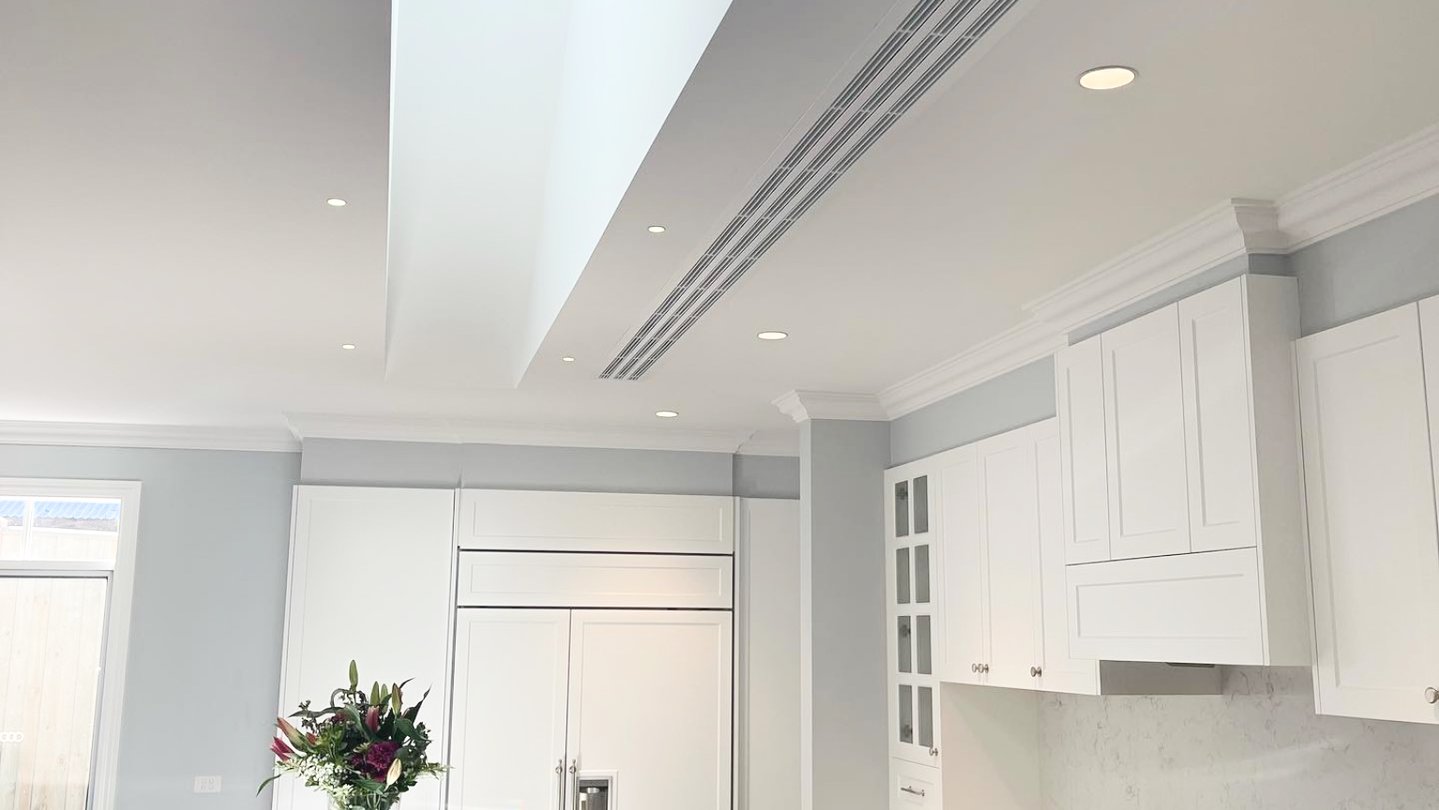
They want linear slot diffusers running wall-to-wall because "it looks clean." You, the installer, know that if you don't calculate the throw distance correctly, that sleek black slot is going to dump freezing cold air directly onto the Receptionist’s neck.
In commercial heating and cooling services, aesthetics matter, but thermal comfort pays the bills. If the air doesn't mix properly before it hits the occupied zone, you will be plagued by warranty calls for "drafts" and "stuffiness."
Here is the technical guide to selecting the right commercial grilles, balancing the architect's vision with the physics of airflow.
The Physics: Throw, Drop, and Coanda
Before we look at the catalogue, we need to respect the physics. When selecting commercial HVAC supplies in Melbourne, you are balancing three variables:
- Throw: The distance the air stream travels from the outlet to a terminal velocity of 0.5 m/s (or 0.25 m/s for critical comfort zones).
- Drop: The vertical distance the air falls as it travels.
- The Coanda Effect: This is your best friend. It is the tendency of a fluid jet to stay attached to a convex surface. In a ceiling grille, we want the cold air to "stick" to the ceiling as long as possible to mix with the room air before dropping into the occupied zone.
Diffuser Types: When to Use What
1. Linear Slot Diffusers
- The Aesthetic Choice: Architects love them. They disappear into the ceiling grid or shadow lines.
- The Challenge: They have a high pressure drop and narrow throw patterns.
- Best For: Perimeter heating/cooling or high-end boardrooms.
- Installer Note: You must use a properly sized cushion box. If you connect flex directly to the back of a linear slot without a plenum, you will get uneven airflow and massive noise issues.
2. 4-Way Blow / Bevelled Edge Diffusers
- The Workhorse: The standard square ceiling diffuser.
- The Advantage: Excellent Coanda effect. They spread air in four directions, maximizing the mixing zone.
- Best For: Open plan offices with standard T-Bar ceilings (2.7m height).
3. Swirl Diffusers
- The Comfort King: These use vanes to induce high turbulence at the face of the diffuser.
- The Advantage: High induction. They mix the supply air with room air almost instantly. This allows you to supply colder air (low temperature) without causing cold drafts.
- Best For: Variable Air Volume (VAV) systems and high-comfort zones like meeting rooms.
The Selection Guide: Throw Distance Table
Use this table as a quick reference when scoping your next commercial fit-out.
(Note: Values are approximate based on standard supply air temperatures).
Diffuser Type | Ceiling Height | Typical Throw (m) | Ideal Application |
Linear Slot (1-Slot) | 2.7m - 3.0m | 2.0m - 4.0m | Perimeter glazing washing |
Linear Slot (2-Slot) | 2.7m - 3.5m | 3.0m - 5.0m | Meeting rooms, executive offices |
4-Way Bevelled | 2.4m - 3.0m | 1.5m - 3.0m | Standard T-Bar Grid Offices |
Swirl Diffuser | 2.7m - 4.0m | 1.0m - 2.5m (Radius) | High comfort, VAV systems |
Jet Diffuser | > 4.5m | 10m - 25m | Warehouses, Shopping Centre Atriums |
Dealing with Noise (NC Ratings)
In a factory, noise doesn't matter. In a law firm's boardroom, a whistling grille is a disaster.
Every grille has a Noise Criteria (NC) rating based on the airflow (L/s).
- Standard Office: Target NC 30-35.
- Boardroom: Target NC 25-30.
The Trap: Do not undersize the grille to save money. If you push 400 L/s through a grille designed for 250 L/s, the velocity spikes, and the grille will generate noise (regenerated noise). Always size the grille for the maximum airflow, not the average.
High Static Units & Grille Selection
If you are using grilles for high static units, like the Compact Comfort range, in a tight ceiling void, you have the pressure required to push air through restrictive linear slot diffusers.
However, the high pressure means you need to be even more careful with your plenum box design. A high-static unit pushing 150Pa needs a heavy-gauge, internally insulated cushion box to absorb the breakout noise before it hits the grille face.
Getting the Design Right
Commercial heating and cooling services are about precision. You can't guess the airflow, and you certainly can't guess the throw distance.
If you are quoting a plan that has complex architectural requirements or high ceilings, don't risk a callback. Send the plans to our Design & Estimation team. We model the airflow according to AIRAH DA03 standards to ensure that the grille you install delivers the comfort the client expects.
Ready to Nail Your Next Commercial Quote?
Stop guessing your air throw and static pressure. Our Design & Estimation team can provide full mechanical layouts and grille schedules that ensure a quiet, comfortable, and compliant install every time.
Don't risk a callback on your next office fit-out. Contact Our Design Team Now or visit our Keilor, Dandenong, or Shepparton branches to see our full range of commercial diffusers in person.
FAQs
Q: What is the Coanda effect in HVAC?
It is the tendency of a jet of air to stay attached to a flat surface (like a ceiling). This allows the air to travel further across the room before dropping, providing better mixing and comfort.
Q: Can I use linear slot diffusers for heating?
Yes, but you must be careful. Hot air stays high. If the velocity isn't high enough to push the air down to the floor, the room will stay cold at foot level.
Q: Why is my swirl diffuser making a "booming" noise?
This is usually caused by excessive air velocity or a poorly fitted plenum. The air is hitting the internal baffles too hard. Check your fan speed and static pressure.
Q: How do I balance a system with different types of grilles?
You must use volume control dampers (VCDs) in the branch ductwork. Don't try to balance the system purely by closing the blades on the grille face, as this causes noise.
Q: Do you supply custom-coloured grilles?
Yes. While standard white is stocked, we can powder-coat grilles to any Dulux colour to match the architect's vision.
Q: What is the best grille for a low-ceiling office?
A linear slot diffuser with a horizontal throw is usually best. It keeps the air moving along the ceiling rather than blowing directly down on desks.
Q: How do I calculate the required throw distance?
Generally, the throw distance should be roughly 75% of the distance from the diffuser to the wall or the halfway point between two diffusers.
Recent
-
Commercial Ducting Supplies Melbourne | Vic Air
26 Aug 2026 -
HVAC Estimation Service for Commercial Contractors | Vic Air
26 Aug 2026 -
iZone for Multi-Res & Commercial Builds | Vic Air
20 Aug 2026 -
In-House Sheet Metal Fabrication Melbourne | Vic Air
20 Aug 2026 -
Lightweight Duct vs Sheet Metal Ducting | Vic Air
20 Aug 2026 -
Ducted Air Conditioning No Roof Cavity | Vic Air Supplies
14 Jul 2026 -
Replacement Ducted Heating Vents Melbourne | Vic Air Supplies
14 Jul 2026 -
Linear Slot Diffuser Specification Guide | Commercial HVAC Melbourne | Vic Air
10 Jun 2026 -
Compact Comfort for Architectural Homes | Vic Air
10 Jun 2026 -
iZone Air Conditioning Melbourne | New Home Build Specification Guide | Vic Air
6 May 2026
Categories

© Copyright 2025 Vic Air Supplies | Websites with MOBLE