
Sheet Metal Ductwork vs Flexible Duct | HVAC Guide
Blog | 3 Feb 2026 |
Flex vs. Rigid: When to Order Custom Sheet Metal (And Why)
Every residential installer loves flexible duct. It comes in a box, it’s cheap, and you can snake it around a truss without thinking twice. If you are doing a standard domestic rough-in on a single-storey house, flex is king.
But flex has a limit. We see too many systems where the installer has tried to run 15 metres of flexible duct, squashed it through a tight bulkhead, and then wondered why there is zero airflow at the grille.
To deliver a system that actually cools the room (and doesn't kill the fan motor), you need to know when to stop pulling flex and when to order sheet metal ductwork.
Here is the no-nonsense guide to mixing rigid and flex for the best result.
Table of Contents:
- The "Spaghetti" Problem
- The Physics: Friction and Static Pressure
- When to Stick with Flex
- When to Switch to Rigid Sheet Metal
- The Hybrid Approach: The "Trunk and Branch" System
- How to Order Custom Metal (Without the Headache)
- Frequently Asked Questions
The "Spaghetti" Problem
We’ve all seen it. You pop your head into a roof void and it looks like a bowl of silver spaghetti. Duct runs are crossing over each other, sagging between joists, and crushed under platform walkways.
This is "lazy" HVAC. While it might have been fast to install, it is a disaster for performance. Flexible ducting relies on being pulled taut. When it sags or snakes, the internal resistance skyrockets. The unit screams, the power bill goes up, and the client calls you to complain that the back bedroom is "stifling hot."
The Physics: Friction and Static Pressure
Air acts like water. It wants the path of least resistance.
- Flexible Duct: The inner core is ribbed (spiral wire). Even when pulled tight, that ribbing creates turbulence. Air hits the ribs and slows down. If the duct is compressed or kinked, that turbulence turns into a blockage.
- Sheet Metal: The surface is smooth galvanised steel. Air glides over it with minimal friction.
The Rule of Thumb: Flexible duct has roughly double the friction rate of rigid metal duct at the same diameter. To get the same airflow as a 300mm metal pipe, you often need to upsize to a 350mm or 400mm flex.
When to Stick with Flex
We aren't saying flex is bad. It is an essential part of the trade. You should use it for:
- Final Connections: The last 1-3 metres from the branch take-off to the boot/diffuser.
- Sound Attenuation: Flex is a great silencer. A short run of acoustic flex between the unit and the rigid trunking absorbs fan noise.
- Truss Navigation: When you need to offset slightly around a timber brace.
When to Switch to Rigid Sheet Metal
You should be ordering custom sheet metal ductwork when the job demands performance or space is tight.
1. The Main Trunk
On a large ducted system, your "backbone" should be rigid. By running a metal trunk line down the centre of the house and tapping off with short flex runs, you maintain velocity and static pressure right to the end of the line.
2. Tight Bulkheads
If you are working in an apartment or a modern architectural home with flat roofs, you don't have space for round flex. A 300mm round flex actually needs about 350mm of height to sit without crushing.
Custom sheet metal can be rectangular. We can fabricate a duct that is 600mm wide but only 150mm high to slide into a tiny ceiling void. It carries the same air but fits where flex cannot.
3. Long Runs
If you need to move air more than 6-8 metres from the unit, use metal. It ensures the air actually arrives at the destination.
The Hybrid Approach: The "Trunk and Branch" System
The most profitable installers use a hybrid method. They don't waste time running metal to every single outlet, but they don't choke the system with all-flex.
- Step 1: Order a custom supply air plenum and a rigid main trunk from our manufacturing shop.
- Step 2: Install the trunk down the main hallway void.
- Step 3: Use simple start collars (spigots) to tap off the metal trunk.
- Step 4: Run short lengths of R1.0 or R1.5 flex to the diffusers.
This gives you the airflow of a commercial system with the install speed of a residential one.
How to Order Custom Metal (Without the Headache)
A lot of tradies are scared of metal because they hate drawing it. They worry they will get the measurements wrong and be stuck with a piece of expensive steel that doesn't fit.
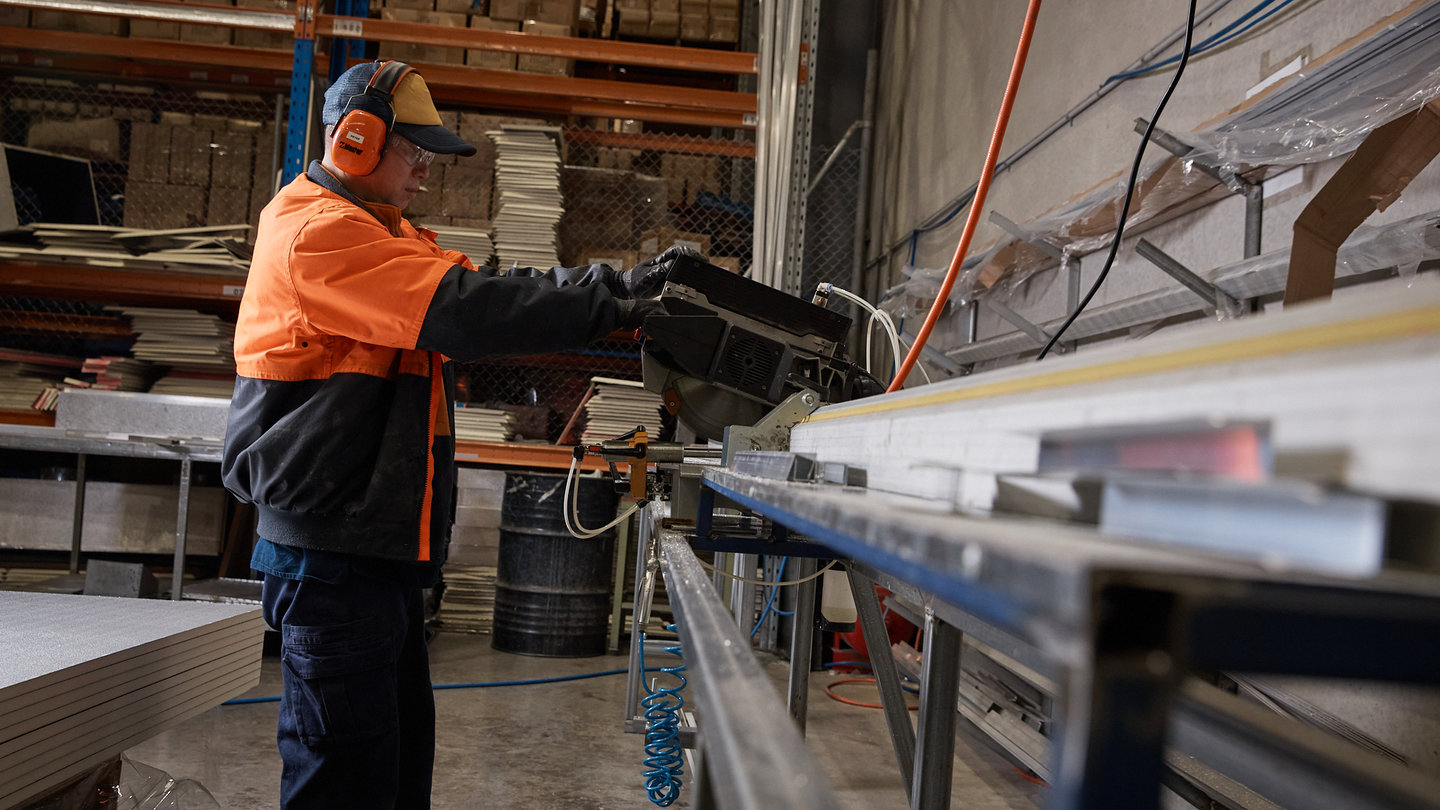
At Vic Air Supplies, we make it easy. We manufacture in-house at our Keilor Park and Dandenong South facilities.
- Sketch it: We don't need a CAD drawing. A clear hand sketch with dimensions (Length, Width, Height) is fine.
- Bring it in: Drop it at the counter or email it to the Design & Estimation team.
- We Build it: We fabricate plenums, transitions, droppers, and risers to order.
Stop choking your systems. Don't let a $50 saving on flex ruin a $5,000 install. Visit the manufacturing teams at Vic Air Supplies to get your custom metal sorted for your next job.
FAQs
Q: What is the maximum length I should run flexible duct?
Ideally, keep runs under 6 metres. If you need to go further, check the static pressure capability of the fan. If you are going over 8-10 metres, you really should be transitioning to rigid duct or Light Weight Duct.
Q: Is Light Weight Duct (board) better than sheet metal?
It is a great alternative. It is lighter to lift and has insulation built-in (pre-insulated). However, for exposed areas or areas prone to rodent damage, galvanised sheet metal is still the strongest option.
Q: How do I join flex to sheet metal?
Use a "starting collar" or spigot. You cut a hole in the metal duct, insert the spigot, and strap the inner core of the flex to the spigot with a duct strap and tensioning tool. Always tape the join with silver foil tape to seal air gaps.
Q: Does metal ducting need insulation?
Yes. If it is in a roof space, bare metal will sweat (condensate) in summer and lose heat in winter. We supply sheet metal that can be lined internally with acoustic insulation (NC) or wrapped externally with thermal blanket.
Q: Can you make offsets?
Yes. If you need to dodge a beam, we can fabricate an "S" bend or offset transition to get you around the obstacle without crushing the airflow.
Q: What is the lead time on custom metal?
It depends on the complexity. Simple plenums are fast. Complex transitions take longer. Contact your local branch for current factory lead times.
Q: How do I open an account to start using this?
Round spiral is excellent for airflow and is self-sealing, but it takes up more vertical height. Rectangular duct is used when you need to flatten the profile to fit in a ceiling.
Recent
-
Commercial Ducting Supplies Melbourne | Vic Air
26 Aug 2026 -
HVAC Estimation Service for Commercial Contractors | Vic Air
26 Aug 2026 -
iZone for Multi-Res & Commercial Builds | Vic Air
20 Aug 2026 -
In-House Sheet Metal Fabrication Melbourne | Vic Air
20 Aug 2026 -
Lightweight Duct vs Sheet Metal Ducting | Vic Air
20 Aug 2026 -
Ducted Air Conditioning No Roof Cavity | Vic Air Supplies
14 Jul 2026 -
Replacement Ducted Heating Vents Melbourne | Vic Air Supplies
14 Jul 2026 -
Linear Slot Diffuser Specification Guide | Commercial HVAC Melbourne | Vic Air
10 Jun 2026 -
Compact Comfort for Architectural Homes | Vic Air
10 Jun 2026 -
iZone Air Conditioning Melbourne | New Home Build Specification Guide | Vic Air
6 May 2026
Categories

© Copyright 2025 Vic Air Supplies | Websites with MOBLE